
At The Intersection: Anthropic Shadow

Any runner who has pushed themselves has experienced the mental space known as the “pain cave.” It’s a liminal and abstract space that the brain goes to when the body is enduring an intense, sustained, often anaerobic effort that rides the line of success and collapsing failure. Every runner has their own pain cave. It’s a weird state, meant to be avoided when possible and endured when absolutely necessary. For most of human history, the pain cave meant you should stop whatever you’re doing before you die. These days it usually just means you’re about to get a new MileSplit personal record in carbon-plated shoes.
The pain of that cave is a difficult one to describe, as it’s “not the pain of a burning stovetop. It feels like weakness… like weight that can’t be borne, panic that can’t be controlled” (Moore 199). Some make a little home out of their cave, hanging posters and decorative lights. Some use it as a dark mine in which they scrape away, layer by layer, at their walls of mental and emotional fortitude. My pain cave has become a comforting space for me. When I’m there, I know I must be working hard enough to justify my existence.
The cave used to scare me. I struggled to cope with the thoughts that bombarded me every time I descended the ladder to go inside. The dark thoughts were either questions or numbers. Much of the cave was populated by numbers, which were the times on which I had hung much of my identity. ‘Sub-20’, ‘sub-19’ and ‘sub-11:30’ were some of the repeat offenders. My pain cave closet of choice for the past two years has been the space between 18:00 and 17:59. The distance between these two numbers is real – a large, gaping chasm through which I haven’t yet passed.
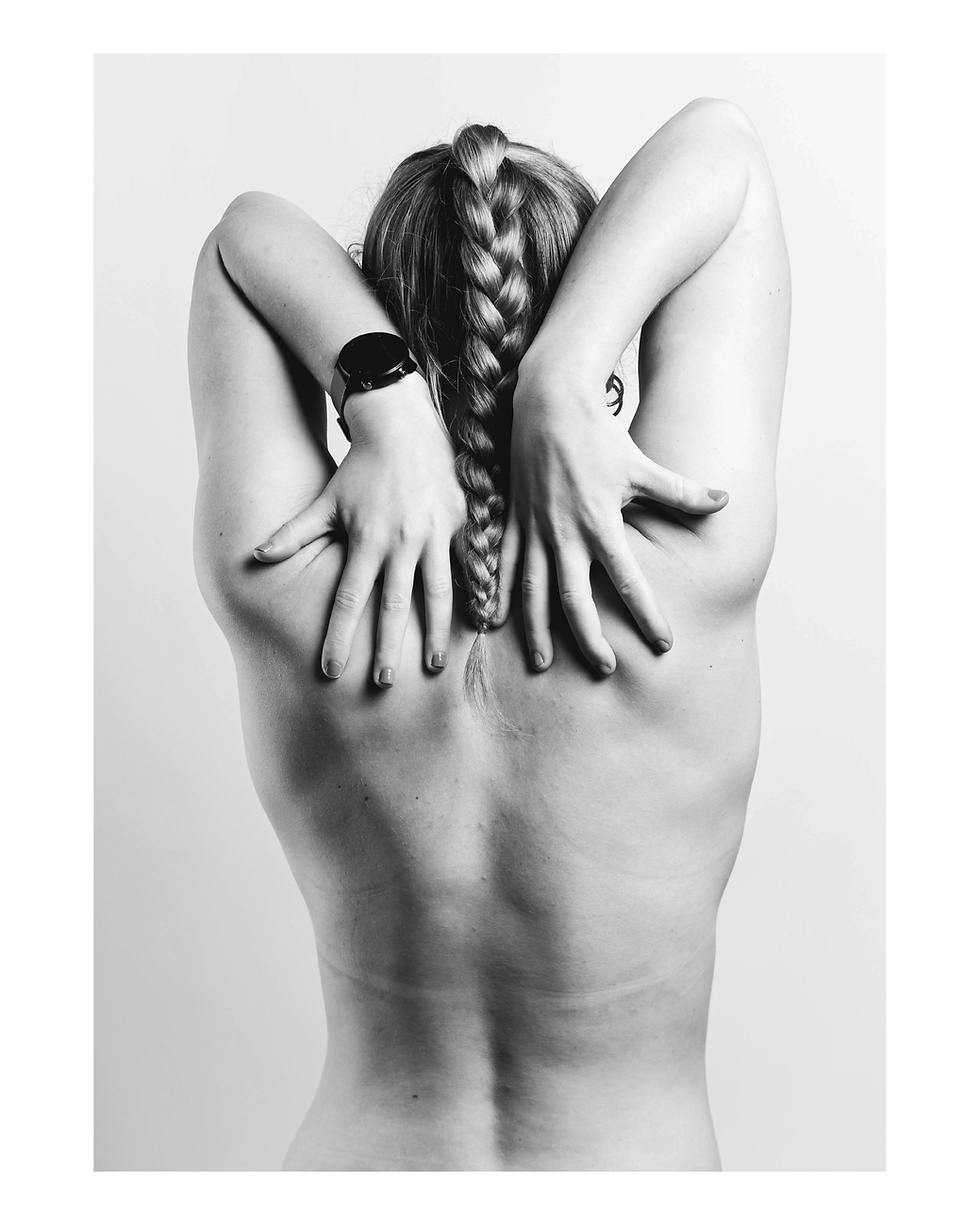
I used to feel that behind each of these race times I hadn’t yet achieved, sat a heightened version of myself. A woman who was stronger, better liked, easier to respect and more impressive. Without ever consciously making this decision, it was established in my brain that my loved ones’ care for me was dependent on me bridging the void between these numbers. If I could just fit myself into this race time, straining and squeezing, maybe I wouldn’t feel so guilty for taking up space. I’d make myself mean something. I’d be a part of that category of women who had also achieved that time status and therefore equate my worth with theirs, which had to be more than my own.
My view on my body became another relationship that depended on numbers on a stopwatch as a form of justification. If I could just manage to have that number beside my name in the race results, maybe I would feel justified in not being as naturally slender as the other girls on the starting line. I wouldn’t question the width of my thighs or the cup size of my bra if it meant that I was capable of running faster than them. “See, look what it does for me!” I so desperately wanted to yell at myself, and the world. You can’t hate your body if it’s doing what you tell it to, right?
This understanding of our own capacity for strength and risk is exemplified in the physics theory of the “anthropic shadow” which is based on physicist Brandon Carter’s discovery of the “anthropic principle” in the 1970s. A multitude of research describes it better than I ever could: “anthropic shadow: the observation selection effect implicit in conditioning on our present existence prevents us from sharply discerning magnitudes of extreme risks close (in both temporal and evolutionary terms) to us” (Ćirković et al., 2010, p.1500). In short, it is the idea that we can only hypothesize the risk of human extinction based on the ways in which we already know humans to exist. As living beings, our capacity for risk is based entirely on our previous experiences. It is ‘the blind spot created by our own existence.’
The parallels to running slapped me in the face. Our physical and mental self-awareness, our capacity for risk analysis and pain management – they all are dependent on previous experiences, decisions and outcomes. If I have decided that my value as a daughter hinges on what number of minutes and seconds I can run 5 kilometers in, and I have found that the desired outcome is emotionally effective, I have no logical option but to continue believing it. I’m breaking this complex scientific and philosophical theory down into the tiniest morsel of sense in order to prove a nearly unrelated point, so I understand how reductive the following ideas are.
This theory works just as well in reverse. Consider that “...correcting for the anthropic shadow bias can significantly affect probability estimates for catastrophic events, such as supervolcanic eruptions or asteroidal impacts. Moreover, recognizing this bias can help us to avoid pitfalls and errors in risk analysis,” (Ćirković et al., 2010, p.1504). Feeling anxious that I won’t run a personal best in a race and understanding that an asteroid could hit earth are two very different types of risk analyses, but both inform the brain to proceed with caution. Ultimately, the anthropic shadow tells me that the possible outcomes of a race are informed entirely by previous experiences.
This 2025 cross country season of my junior year was about creating new experiences and a new narrative for myself in racing. I tried, for the first time since junior high, not feeling like I was going to throw up or cry on the starting line. I repeated affirmations of my safety and self-worth over and over to myself as I warmed up, reasserting that yes, I am not in any danger and yes, I am loved regardless of the outcome. I worked through the deeply ingrained dependence between my athletic performance and my relationships with others. Most importantly, I made the conscious decision that my relationship with myself is not dependent on my athletic performance.
These ideas of safety, self-worth and love are all easy to say out loud and much harder to execute in real life. When you start competitive sports at a young age you tend to subconsciously create a set of rules for yourself. They’re emotional regulators, acting as filters through which you make the world of sports make sense. For me, those rules centered around the idea that hard work cannot coexist with having fun and that I can make my loved ones happy by performing well. Over the ten years that I’ve been running competitively those rules have morphed into safe guards rather than hard and fast rules. They became the lens through which I saw the world, informing my impossibly high standards for myself. It worked for the most part, but ultimately the walls came crashing down enough times and loudly enough that I had to wake up to how unhealthy these mental habits were.
These unhelpful habits of performance-based self-image took years to create and then years to dissolve. One example of dozens of that belief system failing came on a Saturday morning in fall of 2024, sitting at a hotel room desk in Louisville, Kentucky. I was on the phone with my parents, on the verge of tears because we had driven ten hours to get there that weekend, only for me to catch a cold the night before the race. I was certifiably freaking out, talking myself down a mental spiral of anxiety and unrealistic expectations. My mom called me out, telling me to “either shit or get off the pot” – make up your mind. You’re here, are you going to run hard or not? It broke my self-absorbed anxiety bubble and started to wake me up to how strange my whole mental space in the situation was. My throat hurt and I had to run a race, is it really that life-threatening? Of course it wasn’t, but when you’re in that stupor of believing that the way the people around you treat you will be dramatically affected by the quality of your athletic performance, a sore throat feels like the grounds for a breakdown.
Scientific research around the anthropic principle states that “the past-future symmetry is broken by the anthropic shadow” (Ćirković et al., 2010, p.1502). This cross country season for me was the breaking of the anthropic shadow. It was proving to myself that new, more positive experiences within racing are possible and through those experiences I can create a new relationship with running competitively. Past experience informs my worldview, yes, but that doesn’t mean I have to live by those standards of pain and self-doubt.
Flash forward to fall of 2025: I’m standing on the spray painted starting line of the NAIA National Championship in Tallahassee, Florida. Two minutes until the gun. I’m surrounded by the other 330 fastest women in the NAIA and more specifically, my six teammates, all of us wearing white uniforms with our college’s black bee emblem on the front. I’ve had a tumultuous but overwhelmingly successful and joyful cross country season but not because of entirely good results or amazing races. The joy came from intentionally creating a new narrative for myself around racing, one in which I competed in order to celebrate my hard work and lift up my teammates. It’s an idealistic way to view competition which, if done correctly, will always be a struggle, but it’s worth the effort of romanticizing.
I always hated when professional runners’s advice to young runners was to “just have fun.” I always struggled to understand where the fun came in outside of easy runs and stretching before and after practice. What do you think I’m trying to do over here, not run as fast as I can? It’s pretty hard to have fun when you’re keeled over, struggling to breathe on the infield of lane one. The fun for me was always found in the satisfaction of completing a job well done.
When you have impossibly high standards for successful completion, a job well done is hard to come by. Former Olympian and professional runner Kenny Moore describes the standards of competition as a journey down a road that is full of decisions, each of which ends in a different set of emotions. You finally reach the pain cave and “at that moment, two paths open. You can press on and do well. Or you can back off, regroup, and try to catch up. If you fail at the second, the temptation is to finish humiliated, like a POW broken by torture” (Moore 199). Many runners often relate to this feeling of having to choose between two options in racing: glory in self-destruction or humiliation in defeat. Notice that neither of these options are “having fun.” I’ve had to work through the fun and figure out where I can find it outside of performance. I’ve found the fun of camaraderie and shared suffering to be more fulfilling than any of the individual success. Sweaty hugs, vulnerable tears and breathless yelling are the moments where my cup gets filled.
Being on an athletic team inspires a kind of fellowship. Shared experiences with others create deep emotional bonds and can be another method of reaching past the anthropic shadow and creating new options for emotional experiences. Any athlete who has been a part of a team can attest to how impactful hearing others' experiences in the sport can be, competitive and otherwise. Some of my most formative moments in this sport have been when I have borne witness to some of the best and worst moments of my teammates’ lives. Everything from the personal bests and national medals to the tears and long talks about goals forsaken have shown me the strength of shared experiences. This witness can inspire and teach, showing that other experiences in this sport are possible. Hearing my teammates’ stories of success, failure and growth has shown me what can be possible for myself.
Somewhat annoyingly, this season taught me that genuinely having fun is the origin of good experiences, not the end result. You cannot simply be a certain way by saying so; you have to live that way in order to achieve the results you want in that state of being, which happens through action. I’ve noticed that I perform my best in races when beforehand I’m relaxed and clear-minded with as minimal adrenaline pumping as possible (no pump-up jams for me, unfortunately). I’ve found that the best way to do that is being social with my teammates, but it’s not enough to just say “I’m calm and social.” I have to be laughing, asking questions and high fiving on the starting line. I have to physically embody the actions and live out a way of being before I can actually emotionally feel it. The actualization of this principle has taken a decade to fully learn and I’m sure there will be many more decades of trying and failing.
I’m reaching beyond my personal anthropic shadow by intentionally, manually deciding to change the narrative of my relationship with both running and myself. It’s a journey that I’ll be continuing on for my entire athletic career. It puts me at the intersection of many ways of being. Pride and humility, art and athletics, and ultimately, discomfort and comfort. I’m at the intersection of these narratives, looking both ways, figuring out when to cross.
Works Cited
Anthropic principle: Research starters: EBSCO research. EBSCO. (n.d.). https://www.ebsco.com/research-starters/religion-and-philosophy/anthropic-principle
Ćirković, Milan M., Anders Sandberg & Nick Bostrom (2010) Anthropic shadow: observation selection effects and human extinction risks, Risk Analysis, vol. 30, pp. 1495–1506.
Moore, K. (2006). Bowerman and the Men of Oregon. Rodale.


Comments